06/11/15

Thursday Thoughts: Cornish Saffron Bun

I’ve been invited to talk about my historical novel at Wild Sage in Boulder. Why go all the way to Colorado? Well, I so enjoy the audience reaction when we discuss my book. The trip coincides with my visit to Denver for the Historical Novel Society conference. And the hosts are my daughter Sarah Hoskin Clymer and my son Nicholas J.C. Hoskin; they both live in Boulder with their families.

But here’s the kicker — Saffron Buns will be served. Such a treat! They are a bready mixture stuffed with dried fruits and candied peel, flavored and colored with saffron. They are different, delicious, some say an acquired taste — but  like the pasty characteristic of Cornwall.

Saffron is the dried stamens of a special crocus, plentiful in Spain. To buy it in England you had to sign the poison register. In Cornwall you just went to the chemist’s shop (drugstore). They say that when Phoenician traders came to Cornwall centuries ago they traded for tin with saffron.

Come and try some! My talk will be at Thursday, June 25 at 7:00pm MDT in the Common House, Wild Sage, 1650 Zamia Ave, Boulder, CO 80304.

Could anyone share a favorite recipe?

Cornish Saffron Bun

Cornish Saffron Bun

06/4/15

Thursday Thoughts: Liskeard, my hometown!

So looking forward to visiting my native Cornwall with my daughter Sarah in July on a book tour with my historical novel The Miner & the Viscount. I was born and brought up in Liskeard so it will be a special treat to give a talk in the Liskeard Book Shop.

Liskeard Book Shop

Liskeard Book Shop

The shop is in Barras Street in the heart of the town. This handsome building houses the Liberal Club. My father was the president when I was a boy. I remember watching him play billiards.

I went to kindergarten at Miss Rapson’s school behind this building. Miss Rapson and Miss Wilkes were very strict but taught us to spell and add and subtract.

Liskeard was created a Royal Borough in 1240 so it had the privilege of having two Members of Parliament. And only 32 voters at the time of my story. Read how that worked in Chapter 3.

05/21/15

Thursday Thoughts: John Wesley

One of the most imposing and most important historical characters in The Miner & the Viscount is John Wesley, founder of Methodism.

John Wesley

John Wesley

He visited Cornwall 32 times. The horseback ride from London took 5-6 days. He often stayed at Diggory Isbell’s cottage at Trewint, near Altarnun — which is close to my birthplace at Liskeard.

One of his favorite preaching places is Gwennap Pit with its amazing natural acoustics. In his journal he writes of once preaching there to “two and thirty thousand people, the largest assembly I ever preached to.”

Chapter 68 tells of John Wesley’s first time at the Pit in 1762 when he spoke eloquently against slavery, and reminded his audience of his practical advice about money: “Earn all you can; save all you can; give all you can.”

http://wp.me/p4LySx-bG

05/14/15

Thursday Thoughts: John Caddy

John Caddy

John Caddy


John Caddy grew up in Hibbing and Virginia, iron mining towns on the Mesabi Range of northern Minnesota. His great-grandfather, Tom Caddy, was one of the Cornishmen who came to Upper Michigan for the copper and iron mines in the 1870s and 80s after the collapse of hard rock mining in Cornwall. 

John describes himself as “an aging poet whose spirit is more lively all the time.” He first visited the land of his roots in 1992, performed his poetry and formed close attachments that led to his being made a Bard of the Cornish Gorsedh.

Here is one of his poems about Cornwall and the spirit of its miners. It was published in the book With Mouths Open Wide, New and Selected Poems in the section “Presences the Blood Learns Again”.  Learn more about John at http://www.morning-earth.org


COMING TO GRASS

Cornishman: a man at the bottom of a mine, singing.

They came to grass at the end of the day.
They climbed from the Dark to grass
and carried the Dark up with them.

After a long day of night with only
the head’s candle for light,
after aching hours of sledging iron
against candle-gleamed borer,

Grass was the surface they climbed to
through a thousand feet of Dark—
Over and over they pulled their weight up the rungs
as their hearts rang the ribcage,
to come up to light and grass-green,
but to carry Dark with them unseen.

Dark changed the strong men,
shortened their tempers, stubborned beliefs,
roughened their tongues—
Dark led them to think
they were the ones who could see.

But in the mine, in chapel, in pub,
Bearing this Dark is what taught them to sing.

05/8/15

Thursday Thoughts: Stellar Review

Another heart warming review. This one from an old school friend with high standards of writing, and indeed scholarship:

“I’ve spent most of the last few days reading ‘The Miner and the Viscount’, here in Normandy looking out on the sea and across to Jersey.

“It is a splendid read.  A tour de force.  I can only guess at the hours of writing.

“The  Piran story starts it off with a real bang, and I found everything thereafter deeply absorbing and believable as a portrait of life in that place and at that time.  I especially enjoyed the details of mining and of community festivities, your pictures of justice and authority, the class society and position of women, the difficulties of travel, and much else, convincing and informative.  And at the end, while the goodies win and the baddie gets his come-uppance, and there are prospects of huge social and economic improvements soon to come, private tragedy reminds us that for most people life was to remain a struggle, full of pain.  An absorbing read.

“Congratulations.”

http://wp.me/p4LySx-bq

04/30/15

Thursday Thoughts: Cornish Language Comeback

From “The Miner & the Viscount” Chapter 1

“He prayed, without a book for sustenance and forgiveness. Ro dhyn ni hedhyw agan bara pub-dydhyek; ha gav dhyn agan kendonow kepar dell evyn ni ynwedh dh’agan kendonoryon. They resented the English church that was whittling away at their own language. A hundred years ago their forebears had rebelled against the new prayer book of the established church that made them say it differently: Give us this day our daily bread. And forgive us our trespasses, as we forgive those who trespass against us.”

Readers have asked about the strange looking dialog that they see in my book from time to time, such as this prayer from Preacher Perry at Gwennap Pit. The language is Kernewek, the ancient Celtic tongue that once was the community language in Cornwall. The last “monolingual” speaker was Dolly Pentreath, a fish seller in Mousehole, who died in 1777.

Cornish has enjoyed a revival sparked largely by the Cornish Gorsedh, and especially since Europe last spring recognized the Cornish as a distinct ethnic group. In 1967 the Gorsedh joined with the Federation Old Cornwall Societies to create the Cornish Language Board, Kowethas an Yeth Kernewek, charged with encouraging teaching and publishing in the language. They stressed developing a standard system of spelling and pronunciation, Kernewek Kemmen.

Grand Bard Maureen Fuller leading Gorsedh procession

Grand Bard Maureen Fuller leading Gorsedh procession

Maureen Fuller, Grand Bard of Cornwall and a board member of Kowethas an Yeth Kernewek, was kind enough to provide the translations for my book. They added greatly to the colorfulness and authenticity of the dialog.

www.gorsethkernow.org.uk

http://www.kesva.org

04/16/15

Thursday Thoughts: Natural Amphitheater

The foreboding opening scene of The Miner and the Viscount is set in a magnificent natural amphitheater, Gwennap Pit, just southeast of Redruth. At the time the story opens, and into the early 19th century, Gwennap parish incorporated the great Poldice mine and was dubbed the “richest square mile in the Old World”. Stannary Rolls record sales of tin back in the 14th century. The intensive felling of trees for charcoal to smelt the ore has left a stark moorland landscape. Today Gwennap forms part of the Cornish Mining World Heritage Site.

Gwennap Pit

Gwennap Pit


Gwennap Pit may have been formed by the collapse of a working mine. Mary Fryer is from Illogan in Cornwall, and she told me she had played in the Pit as a girl. Mary is a Tangye and her family is connected to mining. Her great great grandfather Sir Richard Trevithick Tangye manufactured hydraulic pumps used to drain the mines.  He was named after the great Cornish engineer Richard Trevithick.

My wife Penny and I went to Gwennap Pit during our research visit to Cornwall in 2012. I stood at the rim opposite her some 200 feet away and we conversed in normal speaking voices.  She said, “I can hear and understand every single word you say.”

I whispered to myself, “First time in years.” She shouted back, “I heard that!”

Gwennap Pit’s acoustic properties made it a marvelous place for meetings. John Wesley visited Cornwall 32 times and preached at the Pit many times. He wrote in his Journal of preaching there to  “two and thirty thousand souls.” Read Chapter 68 for a description of one of John Wesley’s great sermons, when he charged the gentry to pay heed to those in great need.

Gwennap was owned at one time by the Williams family of Scorrier House, respected Cornish mine operators, who gave it to the Methodist Church in 1978. The famous Lt. Col. J.H. Williams was a descendant who was born in St. Just. He served in World War II with the British Fourteenth Army in what was then known as Burma. He was skilled in training elephants and played a major logistical role in the campaign.  After the war he joined a teak company. I remember when I was a boy at Clifton reading his wonderful book “Elephant Bill” about his experiences.

Researching an historical novel turns up so many connections!


04/9/15

Thursday Thoughts: China Clay

Charleston Harbour, Cornwall

Charlestown Harbour, Cornwall

This is Charlestown Harbour, near St Austell in Cornwall. It was planned by the great engineer John Smeaton, who also designed the Eddystone Lighthouse. Readers of The Miner & the Viscount met him as the innovator of improvements in steam engines and water wheels for the hard rock mines.

Smeaton was helped by William Cookworthy, a Quaker and a pharmacist, who developed hydraulic lime, an essential ingredient in building the lighthouse.

The port was built to export copper from the nearby mines of Crinnis Hill, South Polmear and United Mines, Holmbush. However, it later became an important port for the export of China Clay.

William Cookworthy again played an important part. He developed a process for making china clay and built a factory to produce porcelain. One of his early backers was Thomas Pitt of Boconnoc (later the first Baron Camelford). It was on his land that deposits of saponaceous clay were found.

When I visited Boconnoc for research on my book, the present owner, Anthony Fortescue (whose family married into the Pitts), told me he had managed the family’s china clay pit when he was a young man.

Thanks to www.facebook.com/KernowPhotos for this photo and some of these notes.

04/2/15

Thursday Thoughts: Mystery unveiled at Lanhydrock

AN ANCIENT book has been discovered at Lanhydrock that helped Henry VIII to build his case against the Pope and annul his marriage to Catherine of Aragon, first of his six wives.

We can connect threads here. As readers of The Miner & the Viscount know, Lanhydrock is the great house that is the home of my fictitious villains, the Trenances. Like Lanhydrock House and churchmany Cornish estates, there is a church right by the house. Why? Because it was originally a priory. When Henry VIII brought about the Dissolution of the Monasteries (the greatest real estate scam in history) many priories plundered from the church were sold to wealthy laymen.

The book (dated 1495) is a summary of works by philosopher and theologian William of Ockham who was a major figure in medieval intellectual and political thought. Its contents help explain the persuasiveness of the arguments Henry VIII’s advisers made against the Pope.

The book has been at Lanhydrock for many years, but what has just been discovered is its direct connection to the royal library at Westminster Palace. There is an inventory number inside which corresponds to the inventory prepared in 1542 for Henry VIII’s chief library.

To help  gather evidence to support an annulment to Henry VIII’s his marriage, his agents scoured the country for texts such as Ockham’s which questioned the authority of the Pope and argued for the independence of the monarch. The volume at Lanhydrock contains marginal notes and marks which were made by Henry VIII’s secretarial staff to draw his attention to relevant passages.

So was the Reformation at its root motivated to sweep corruption from the Roman Catholic Church? Or was it Henry’s cover story for schemes truly driven by sex and money? We know he wanted to get rid of his Spanish queen so that he could marry the lusty Anne Boleyn. He also created the opportunity to seize the property of the Church of Rome.
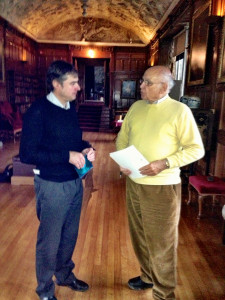
With Paul Holden at Lanhydrock in the Long Gallery

Richard Hoskin with Paul Holden at Lanhydrock in the Long Gallery

Lanhydrock is now in the National Trust. Paul Holden, house and collections manager, said: “To have such an interesting book in the collection is fascinating in itself but to find out that it was once owned by Henry VIII, and played a part in a pivotal moment in British history, is very exciting.

“It’s thrilling to discover that the book at Lanhydrock is from the Royal library. The book is important not only for its provenance but for the notes entered in it by Henry VIII’s advisers and no doubt intended for him to see. They draw attention to precisely the sort of issues that were so relevant to the King’s policies in the years leading up to the break with Rome.”

On a personal note, I owe much to Paul for the expert information he provided me about Lanhydrock and the Robartes family. He added much to the richness of my book.

03/25/15

Thursday Thoughts: Megaliths

Cornwall is rich in neolithic monuments. The famous Cheesewring is near the village of Minions, which was once a tin and copper miming center. The village is some 3 miles from Liskeard, my birthplace.

How was this extraordinary structure created? Was it an example of the engineering feats of our ingenious Celtic ancestors? There is a simpler explanation. The Cheesewring was formed when the saints and the giants were both inhabiting Cornwall. The giants had lived there longer and were annoyed by the saints moving in and ‘taking over’; putting more stone crosses up, making wells holy and taking too many tithes (taxes) from the harvest.

One day St. Tue heard the giants discussing the best way of ridding the county of the saints so he decided to challenge the leader (Uther) to a trial of strength. This took the form of a rock throwing contest and if the saints won then the giants would have to renounce their wicked ways; but if the saints lost then they would have to leave Cornwall, never to return. Uther was a champion rock thrower whose specialty was balancing larger rocks on top of smaller ones, and St. Tue was very small so in theory there should have been no doubt about the result.

After gathering twelve flat rocks of varying sizes Uther took first throw. The rock landed about 100 feet away towards Stowe’s Hill. St. Tue picked up a rock, looked to the skies and suddenly the rock felt as light as a feather in his hand. He cast it toward the first thrown rock and it landed neatly on top. So they continued until there was only one rock left and it was St. Tue to throw. This too landed perfectly on the pile and, not wanting to admit defeat, Uther suggested that they throw ‘one more for luck’.

He picked up a huge stone and using all his strength threw it. It fell short of the pile, rolled back down the hill and landed at the saint’s feet. As the saint prayed for holy intervention an angel, visible only to him, appeared and carried the stone to the pile. Placing it neatly on the top the angel then vanished and the saints had won.

Uther promised to mend his ways and so did most of the other giants, although some went into the hills muttering about revenge.

Cheesewring

Cheesewring